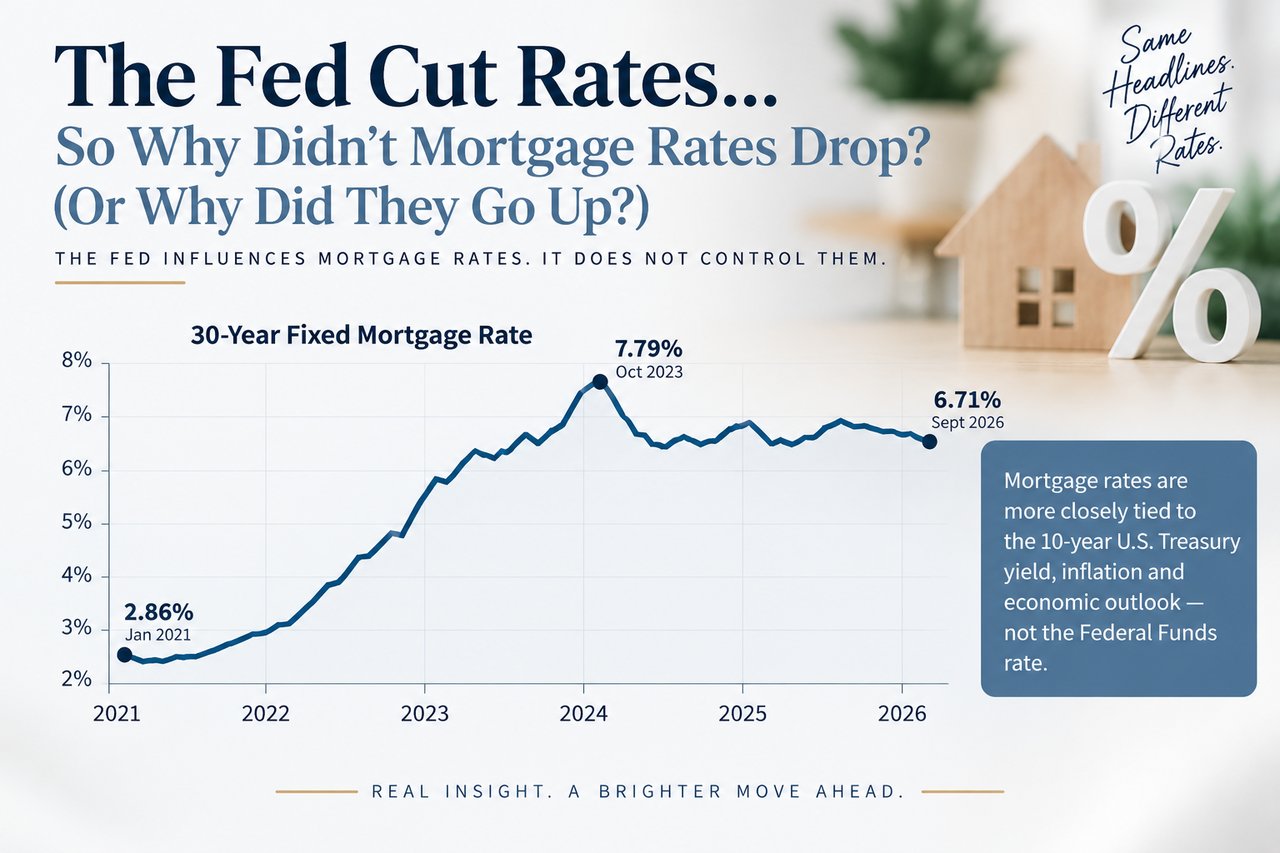
The Fed Cut Rates — So Why Didn’t Mortgage Rates Drop? And Why Can They Actually Go Up?
Every time the Federal Reserve announces a rate cut, I hear some version of the same thing:
“Great! Mortgage rates are going down.”
Not necessarily.
Mortgage rates may go down. They may barely move at all.
They can even go UP after the Fed cuts rates.
Confusing? Absolutely. But it makes much more sense once you understand one important distinction:
The Federal Reserve does not set mortgage rates.
When you hear that “the Fed cut rates,” the Fed is changing the federal funds rate — a very short-term interest rate.
A 30-year fixed mortgage is a completely different animal.
Mortgage rates are much more closely tied to the bond market, particularly the 10-year U.S. Treasury yield, along with inflation expectations, economic growth, investor demand for mortgage-backed securities and expectations about where the economy is headed.
So How Can the Fed Cut Rates and Mortgage Rates Go Up?
Because financial markets are always looking ahead.
If investors were already expecting the Fed to cut rates, that anticipated cut may have been reflected in Treasury yields — and therefore mortgage rates — before the Fed ever made its announcement.
Then new information can change the outlook.
For example, if economic data comes in stronger than expected or investors become more concerned about inflation, long-term Treasury yields can rise.
And when Treasury yields rise, mortgage rates frequently rise with them.
That's why the headline:
“FED CUTS RATES”
doesn't automatically mean:
“MORTGAGE RATES JUST DROPPED.”
We've actually seen this happen.
After the Federal Reserve cut its benchmark rate by half a percentage point in September 2024, the average 30-year mortgage rate subsequently climbed from 6.09% on September 19 to as high as 6.84% by November 21, according to Fannie Mae.
So yes — the Fed cut rates, while mortgage rates went the other direction.
What Should Homebuyers Watch Instead?
If you're trying to understand where mortgage rates may be heading, don't watch the Fed alone.
Pay attention to:
- The 10-year Treasury yield
- Inflation
- Employment and economic data
- Expectations about future Fed policy
- The mortgage-backed securities market
- Overall investor sentiment and volatility
The Federal Reserve matters — a lot — but it is only one part of the equation.
Why This Matters If You're Waiting to Buy
This is where I think buyers need to be careful.
I frequently hear:
“I'm going to wait until the Fed cuts rates before I buy.”
But that's not really a housing strategy.
You could wait for the Fed to cut rates only to discover that mortgage rates haven't moved much — or have actually increased.
And there's another factor to consider.
If mortgage rates eventually do fall substantially, you probably won't be the only buyer who notices.
Lower mortgage rates increase purchasing power and can bring more buyers back into the market. In desirable areas, that can mean more competition for homes and potentially upward pressure on prices.
So instead of trying to perfectly time the Federal Reserve, I encourage my clients to look at the entire equation:
What can you comfortably afford today?
How much negotiating leverage do you have in today's market?
What is happening with inventory and pricing in the specific neighborhood you want?
And does buying now make sense for your long-term plans?
Because if you buy the right property at a price and payment you can comfortably afford, you may have the opportunity to refinance if mortgage rates eventually fall.
But you can't go back and renegotiate the price you paid because ten other buyers jumped into the market when rates dropped.
The Bottom Line
The Fed influences mortgage rates.
It does not control them.
So the next time you hear that the Federal Reserve cut rates, don't assume your mortgage rate just dropped by the same amount.
It didn't.
Mortgage rates are driven largely by what's happening in the bond market and what investors believe is coming next.
And sometimes the market has already made its move before the Fed ever makes the announcement.
Considering buying or selling in San Diego?
Let's look beyond the headlines and talk about what today's rates, inventory, negotiating environment and home prices actually mean for you.
Gina Mancuso | North County Properties
San Diego Real Estate | Luxury • Relocation • Residential
This article is for educational purposes only and is not financial or lending advice. Mortgage rates and loan terms vary by borrower, lender and market conditions.